
Material Selection for Retaining Rings: Carbon Steel, Stainless Steel, and Specialty Alloys
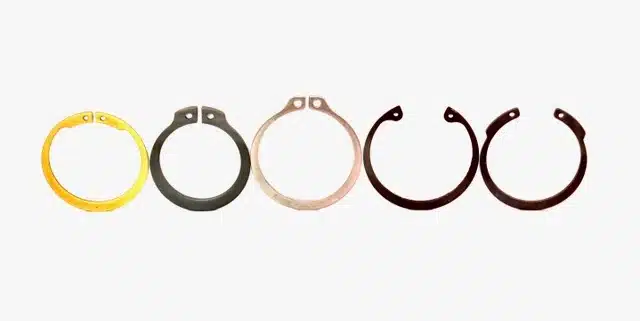
Selecting the right retaining ring material is just as important as choosing the correct ring design. While dimensions determine how a retaining ring fits, the material determines how well it performs over time. Factors such as operating temperature, corrosion exposure, installation stresses, and overall application requirements all influence which material provides the best balance of performance, durability, and cost.
At American Ring, we manufacture retaining rings in a wide range of materials to meet the demands of everything from standard industrial equipment to high-temperature aerospace applications.
Carbon Spring Steel: The Economical High-Strength Choice
For many applications, carbon spring steel remains the preferred material because it delivers exceptional strength at the lowest cost.
Carbon spring steel offers excellent spring properties and maintains its strength at temperatures up to approximately 250°F, making it ideal for general industrial machinery, power transmission equipment, agricultural equipment, and countless OEM applications.
Because carbon steel is susceptible to corrosion, it is best suited for dry or controlled environments. To improve corrosion resistance, carbon steel retaining rings typically receive a protective finish:
- Oil Finish – Standard for wire-formed retaining rings, providing basic corrosion protection during storage and service.
- Phosphate Finish – Standard for stamped retaining rings, offering improved corrosion resistance while providing an excellent surface for lubrication.
When corrosion resistance is not the primary concern, carbon spring steel delivers outstanding performance and value.
Stainless Steel: Strength with Corrosion Resistance
When retaining rings will be exposed to moisture, chemicals, food processing environments, or outdoor conditions, stainless steel is often the best solution.
Unlike carbon steel, stainless steel naturally resists corrosion while maintaining excellent mechanical strength. Different grades provide unique advantages depending on the application:
- 302 Stainless Steel – Excellent general-purpose corrosion resistance and strength.
- 316 Stainless Steel – Superior resistance to saltwater, chemicals, and harsh environments.
- 420 Stainless Steel – Higher hardness and wear resistance for specialized applications.
- 15-7 Stainless Steel – Available for tapered (strip steel) retaining rings, offering high strength with good corrosion resistance.
- 17-7 Stainless Steel – Combines excellent spring characteristics with elevated temperature capability up to approximately 650°F.
Most stainless steel retaining rings maintain their mechanical properties at temperatures up to approximately 400°F, making them an excellent choice when both strength and corrosion resistance are required.
Specialty Alloys for Demanding Applications
Some applications require materials capable of operating under extreme loads, elevated temperatures, or specialized environmental conditions. American Ring offers several specialty alloys designed for these challenging environments.
Chrome Silicon
Chrome silicon provides spring characteristics similar to carbon spring steel but with higher yield strength, making it ideal for applications with exceptionally high installation stresses or where maximum performance is required. Although more expensive than standard carbon spring steel, it is often specified when reliability under heavy loading is critical.
Beryllium Copper
Beryllium copper combines high strength with excellent corrosion resistance while remaining non-magnetic, making it well suited for electrical, aerospace, instrumentation, and specialized industrial applications. It also maintains its mechanical properties at temperatures up to approximately 400°F.
A286 Alloy
A286 is a high-strength alloy that performs exceptionally well in both corrosive and elevated-temperature environments. With operating temperatures up to approximately 1,000°F, it is commonly selected for aerospace, turbine, and other demanding industrial applications.
Inconel Alloys
When applications involve both extreme heat and aggressive environments, Inconel is often the material of choice. Various Inconel alloys provide outstanding strength, oxidation resistance, and corrosion resistance while operating at temperatures reaching 1,300°F, making them ideal for aerospace, power generation, and chemical processing equipment.
Protective Finishes and Plating Options
In addition to selecting the proper base material, surface finishes can further improve corrosion resistance, appearance, or application-specific performance.
American Ring offers several finishing options, including:
- Zinc Plating – Available in both trivalent and dichromate finishes. Trivalent zinc is RoHS compliant, while dichromate zinc is not. Zinc plating provides improved corrosion resistance and is available in silver, brown, or yellow appearances.
- Nickel Plating – Produces a bright silver finish while adding corrosion protection.
- Black Oxide – Provides a uniform black satin appearance. While attractive, it offers less corrosion resistance than phosphate coatings.
Selecting the appropriate finish helps extend component life and ensures compatibility with both environmental and regulatory requirements.
Choosing the Right Material
No single retaining ring material is ideal for every application. The best choice depends on balancing several factors:
- Operating temperature
- Exposure to moisture or corrosive chemicals
- Required spring strength
- Installation stresses
- Regulatory or environmental requirements
- Overall project budget
For many applications, carbon spring steel offers the best combination of strength and affordability. When corrosion resistance becomes critical, stainless steel provides long-term reliability. For extreme operating conditions, specialty alloys such as chrome silicon, beryllium copper, A286, and Inconel deliver performance that standard materials cannot match.
Partner with American Ring
Choosing the correct retaining ring material can significantly improve product life, reduce maintenance, and increase system reliability. American Ring’s engineering team works closely with customers to recommend the best material, finish, and retaining ring design for each application.
Whether your project requires economical carbon steel, corrosion-resistant stainless steel, or a specialty alloy for demanding environments, we can help you identify the right solution for long-term performance.